pyxx.files
Code for reading, writing, and processing files
The pyxx.files module is intended to assist with processing
files. It contains a set of classes intended to represent generic file
types (binary files and text files), as well as functions to perform
common file-related operations (such as computing file hashes).
An important concept about the classes in pyxx.files is that
files are considered a data structure for storing information as a sequence
of characters. Files are not necessarily linked to a location on the disk
(although they can be). Therefore, classes in pyxx.files can, but
do not necessarily, have an assigned path.
The intention of this module is that by subclassing the included classes,
the basic structure should be provided to manage file content, and a few very
general functions are provided. Developers can add custom methods to
subclasses specific to their file format. For instance, if creating a
ShellScript subclass to parse shell scripts, a ShellScript.read()
method might be added that parses the file, extracting the shebang line and
storing the interpreter in an attribute ShellScript.interpreter.
Thus, the focus of the pyxx.files classes and subclasses should,
in most cases, be on processing context-specific file content, and less
focused on specific files on the disk (Python’s built-in pathlib,
shutil, and os modules are already well-suited to these purposes).
File Objects
The classes below are intended to represent files (existing on the file system or not). Once a class instance is created, various read/write and content processing methods are available to perform common file-related tasks.
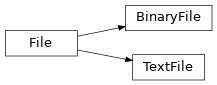
|
Base class for processing files of any type (text or binary) |
|
Base class for processing binary files |
|
Base class for processing text files |
File Hashes
The functions in this section can be used to compute and analyze file hashes.
|
Computes a file hash |